


We put in the grit so you look polished.
Steady leadership isn’t an accident.
It’s an architectural choice.
Welcome to Salt & Script Solutions. I’m Dr. Kelly Martin, and I help school leaders move from systemic grit to operational polish. Whether you’re here for a single tool or a supportive community, you’re in the right place.
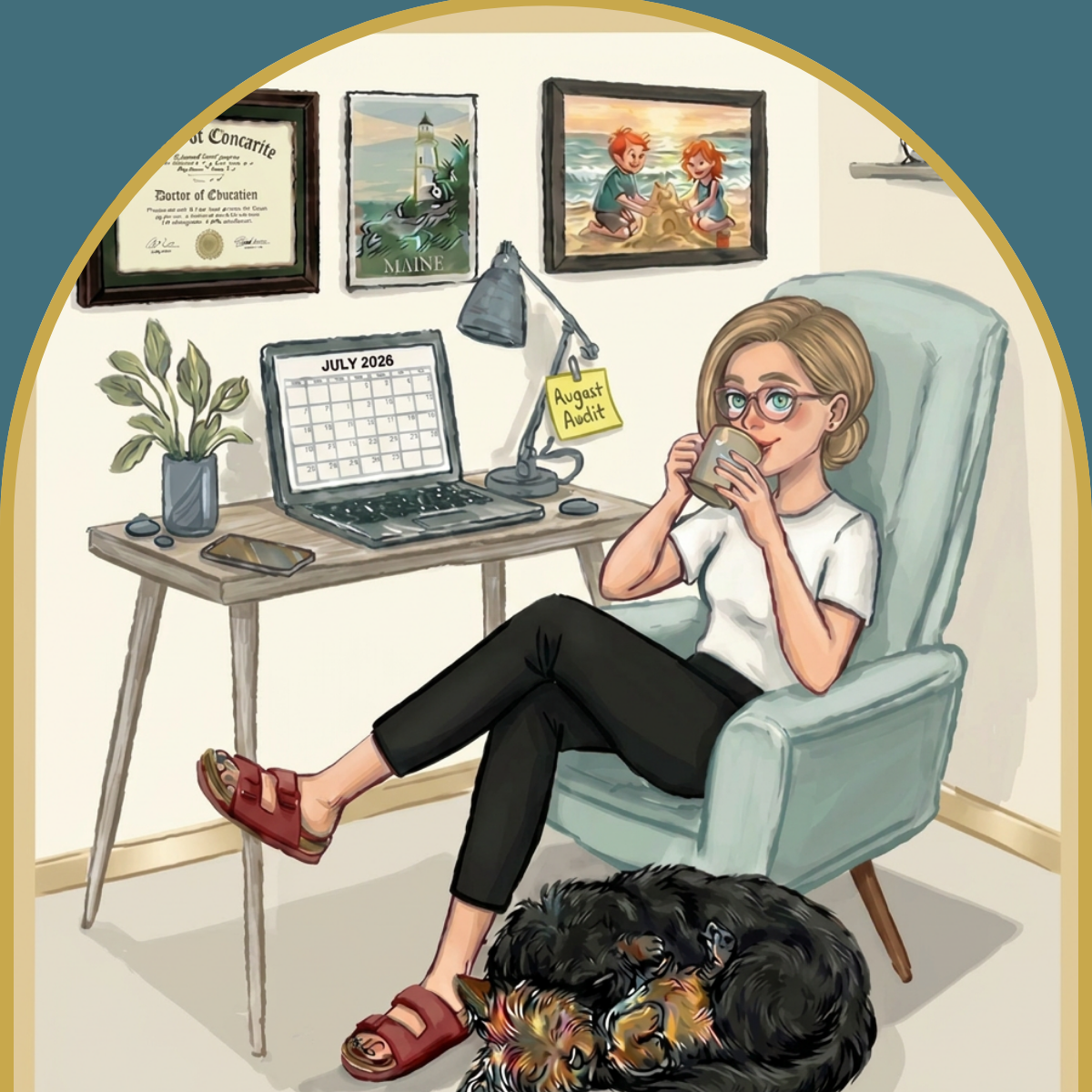
The July Pause: The Architect’s Guide to the Offseason
For school leaders, July isn't just a break. It's the architect's off-season. Here's how to spend it: audit the hard truths, sketch plans that bend, subtract before you add, and plant a flag for January.

48 Hours, 200+ Builders, and the Thing Schools Forgot How to Do: A SheBuilds Hackathon Reflection
48 hours. 200+ women builders. Zero cutthroat competition. What happened inside the SheBuilds Hackathon cracked something open for me - and it has everything to do with why schools are getting it wrong, and what I'm building to change that.

The Re-Entry Tax: Why School Leadership is Failing by Design
You walk out of a meeting to a 'Wall of Noise': 47 unread emails, 12 Teams pings, 3 missed radio calls, and a parent waiting in the front office. By the time you’ve triaged the chaos and found your footing, the instructional walk you planned is gone. The strategic work is buried. This isn't just busyness—it’s the Re-Entry Tax, and it’s costing you up to $15,000 in lost productivity every year.

From Grit to SheBuilds: Reimagining the Architecture of Leadership
The real irony is, all of the things that I miss about being a school leader are the parts that got boxed out by so many other competing priorities.

The Architecture of an Iteration: Rebooting the Campus Hub
The Confession
Two months ago, I thought I had published the Campus Hub 1.0. I was proud of it. It was a revamp the dashboard that I used as a leader with features I never added for myself. I believed in the practice of using a dedicated dashboard due to the positive results and feedback from staff. I wanted to make you the dashboard that I searched for online when I was a principal. In the weeks since publishing that product, I have learned so much and already have a new ‘designer’s’ lens. I couldn’t wait to revamp it again, so Campus Hub 2.0 is here!
The Learning Journey
I’ve spent the last few weeks in the "grit" of the work. I am not an expert who has reached the finish line; I am a learner who is obsessed with the process. I’ve been teaching myself the nuances of UI/UX, refining formula protections, and exploring how a system can be both "heavy-duty" and "light-touch." I love a good puzzle (especially a great crossword on the deck at this time of year) and I find the same satisfaction in solving these gritty architecture challenges. Knowing what I want the outcome to be, why I want it to be that way and how I need it to flow for the user as I run each iteration is…exciting (nerd alert).
This reboot isn't just a "version 2.0." It’s the result of me being willing to tear down the original walls to build a stronger foundation.
What I Learned (And What Changed)
I am learning how to build more efficiently so that you, the user, have a better experience. That is always the end goal. I ripped out the guts of the first hub and rewired it to make the input more streamlined, the interface more simplified, and the output more customized.
You can rebrand the entire architecture—colors, headers, and structure—in the time it takes to drink a cup of coffee.
The Rules of the Road: Why We Can’t Govern What We Don’t Touch
I grew up with a rotary phone and a 50-foot cord on my TV "remote." I wrote my first school reports on an electric typewriter and vividly remember the high school computer class where I first held a floppy disc. It felt like the future.
For me, every technological shift since then has felt like an expansion. I've always had an adventurous spirit about tools, but 20 years in public education taught me a hard truth: Bureaucracy is where exploration goes to die.
I left the system last year to embrace the freedom to build, innovate, and test without the red tape. But looking back from the "other side," I'm concerned about the widening gap between policy and practice.
The Permission Gap
Teachers and administrators are currently being asked to lead through an AI revolution while being denied the very tools and training required to understand it.
It's a common paradox of leadership: we are asking people to set the rules of the road for a vehicle they aren't permitted to drive. When we restrict access in the name of safety without providing a path to proficiency, we don't actually create safety. We create a vacuum.
The Architecture of Discernment
Responsible AI adoption isn't just about picking the right software; it's about building a structural framework for decision-making. At Salt & Script, I call this the Architecture of Discernment.
When I work with leaders to audit their systems, we look through three specific lenses:
Pedagogical Integrity: Does this tool actually support the core mission of learning, or is it just digital noise? What are the specific guardrails for student output?
Structural Security: How does the data flow? Who owns the inputs? If the "engine" changes tomorrow, do you still own your data?
Human Alignment: Who is driving the bus? Is the AI in charge, or is it serving as a high-powered engine for a human architect?
A Structural Failure in Leadership
One of my greatest "ah-ha" moments after leaving the public sector is realizing how much benefit is lost to the "purchase and renew" cycle. Education moves in 3-year increments; AI moves in 3-week increments.
If we don't provide leaders with the "lab space" to learn how to audit, govern, and implement these tools in real-time, we aren't just facing a tech gap. We are creating a structural failure in leadership.
The question for 2026 isn't whether AI belongs in schools. The question is: Are we protecting our systems by restricting access, or are we just ensuring our leaders are unprepared to govern what’s already here? How do we provide a safe spaces for learning and innovation for the people tasked with educating our most precious resource..our kids?
Build your own Architecture of Discernment.I'm currently opening up three spots for "Structural Blueprints"—a 60-minute deep dive to audit your current L&D framework. Book a consultation here.
The Blueprint (How-To/Organizational Architecture)
The Strategic Leadership SnapshotFind the Signal in the Noise.
Leadership is noisy. Between the grit of daily operations and the constant pressure of compliance, it’s easy to lose sight of your Structural Integrity. Most reflections are forced into public goal-setting cycles or team-building sprints—but the most important architecture is the one you build for yourself.
This isn't a performative exercise. It’s a 10-minute "Engine Room" check-up designed to help you find the Signal in the organizational noise.
The Architecture:
Privacy by Design: This is on your terms. No shared dashboards, no team sprints—just a high-fidelity audit for your own strategic clarity.
Structural Alignment: Identify exactly where your foundation is solid and where the "lean" in your systems is creating friction.
Automated Synthesis: Your reflections are instantly transformed into a Leadership Architecture Dashboard, showing you the "Polish" in your current "Grit."
Download Your Private Architecture Blueprint(Clicking the link will prompt you to make a private copy in your Google Drive)

Founder’s Friday Manifesto
Founder Friday: It’s been a week.
Seven days ago, I was deep in the "Grit" of pivot-mode. Today, I’m looking at a live brand, a "Gold Master" architecture in the market, and a +233% surge in profile views.
The biggest takeaway from my first full week as Founder of Salt & Script Solutions? The power of the "Human-in-the-Loop."
In education, we were often taught to fear AI. But this week, I’ve used it to architect 180-day engines, launch a digital storefront, and scale my efficiency to a level I never thought possible in my 20 years of school leadership.
AI didn't build the brand. I did. But AI was the engine that helped me bridge the gap between "Survival Mode" and "Strategic Launch."
My Founder Friday reflections:
The Grit: Moving through the fear of a new tool.
The Polish: Realizing that when the human is the architect, the tool is a superpower.
Shoutout to my AI thought partners this week:
Littlebird
Claude Code
Google Gemini
Canva